
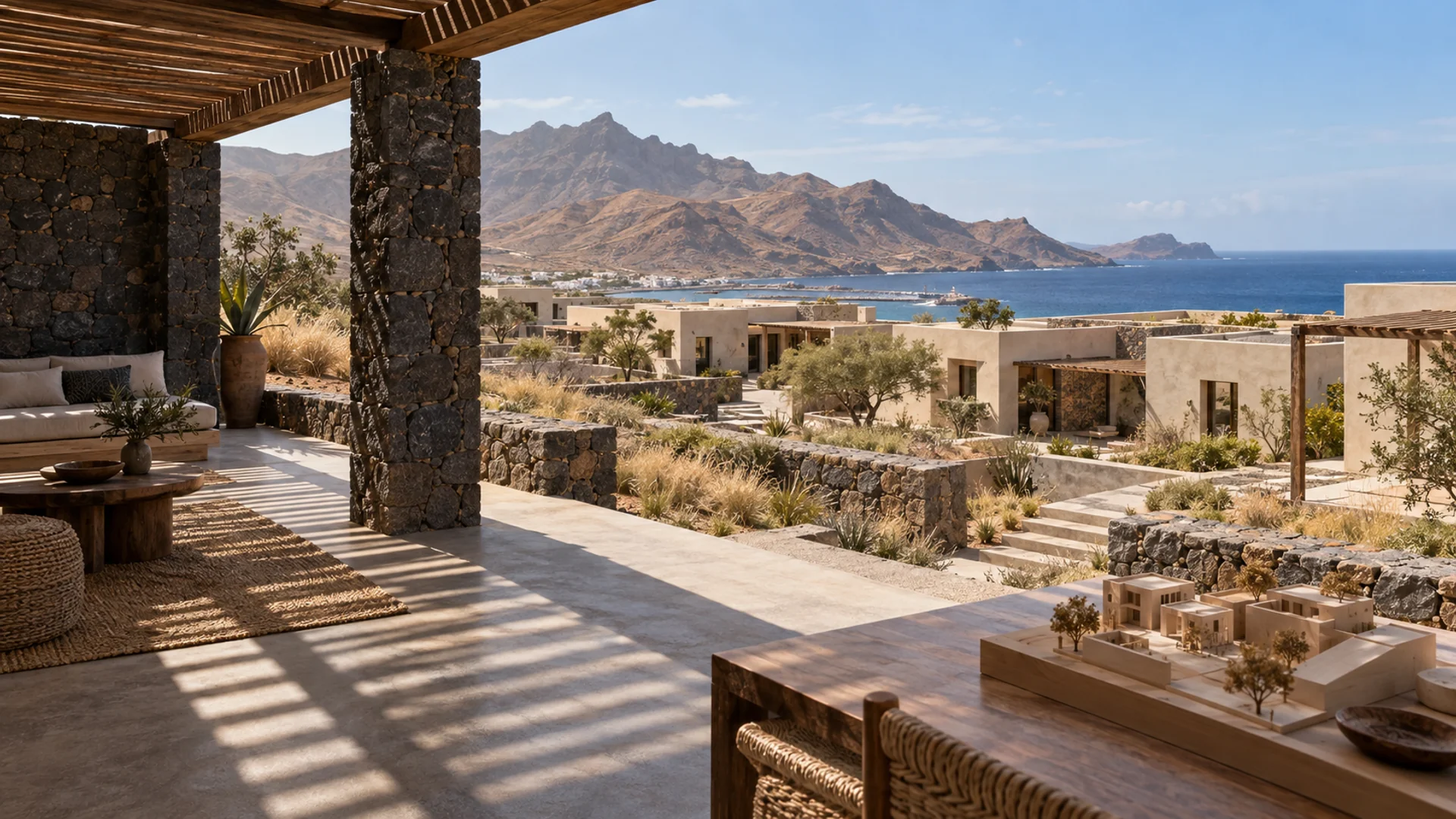
Turning a real estate idea into a realisable project requires a sequence of decisions: asset availability, territorial compatibility, economic feasibility, resources and operational responsibility. This guide assists international and local developers in preparing the discussion with MGM, from the initial dossier to handover.
Define a project that can be assessed
The starting point is a brief, concrete document: location, asset concerned, available rights, proposed use, end client, indicative size and resources. Documented elements must be distinguished from hypotheses still to be verified.
If you already own land, gather the documents that identify its position, area and ownership. If you are evaluating a purchase, clarify the stage of the negotiation. If you only have an idea, start from product and market requirements, without presenting a site or building capacity as already acquired.
An organised initial dossier enables you to decide which checks to commission. You do not need all answers to start: you need to know which answers are missing.
Choose the location and the property concept
An operation in Boa Vista cannot be automatically transferred to Santiago, Sal, São Vicente or Maio. The discussion must consider demand, accessibility, services, supplies, soil characteristics and future management organisation. The availability of water, electricity and access must be verified on the specific site, together with timelines and costs of any required works.
The product must be consistent with its users: primary residence, second home, hospitality or other uses require different models. Spaces, quality, maintenance and services need to be clarified before finalising the economic model.
MGM assesses locations across the archipelago according to each initiative. Locations being considered do not necessarily have construction underway. For the developments presented and their current status, see MGM projects.
Check rights, planning and environmental requirements
Land availability and the possibility of delivering a specific project are matters to be examined separately. Appointed professionals must verify rights, encumbrances, boundaries, access, permitted uses and applicable conditions for the site.
The Instituto Nacional de Gestão do Território operates in territorial planning, cadastre and geographic information. Its resources help identify territorial references; applying them to an individual asset requires consultation with the competent authorities and current documentation.
The government sheet on Decree‑Law No 27/2020 refers to the environmental impact assessment regime for projects likely to have significant environmental effects. For each initiative, applicability, updated procedures and any regulatory changes must be verified. One should not assume that all projects follow the same process.
The useful outcome is a list of checks and obligations, with status, responsible party, required documents and dependencies. A preliminary opinion, a submitted application and a granted authorisation are distinct stages and must remain distinguishable in the dossier.
Establish financial feasibility
Feasibility links the technical project, market, costs and timetable. The value of land must be considered together with the cost required to turn it into a usable product: studies, design, infrastructure, works, charges, supplies, marketing and initial management.
For the main items, comparable quotes and a clear scope are needed: quantities, quality, transport, any import compliance, installation, warranties and maintenance. A price lacking these conditions is insufficient to compare two solutions.
The plan must show when resources are needed and which revenues are expected. Revenue assumptions should be accompanied by a sensitivity analysis for delays, higher costs and slower sales. A contingency reserve must be sized and justified for the project, without using a generic percentage as a coverage guarantee.
A useful outcome of this stage may be to proceed, downsize, change the use or stop. Recognising a constraint before incurring significant costs is part of the development work.
Agree how to work with MGM
MGM can support a developer in specific areas or across a broader scope, as agreed. The page for developers explains the services and ways of working together.
- Mandated services: analysis, coordination or defined operational activities, with agreed performance, fees and responsibilities.
- Co-development: possible participation in the project, including capital, when the parties' assessments and interests are aligned. Contributions, powers and profit distribution require specific agreements.
- Structuring and banking relationships: assistance in preparing the dossier and in dialogue with local counterparts, where agreed. Credit decisions remain with the bank; timelines, availability and conditions cannot be taken as guaranteed.
Local knowledge facilitates work organisation. Authorisations, professional assessments and decisions of the competent authorities retain their own processes and responsibilities.
Assign responsibilities and decision-making roles
Before the operational phase, a shared framework is needed of who prepares, who verifies and who approves. Professional assignments and responsibilities required by the applicable legislation must be formalised for the specific case.
- Developer and ownership: objectives, resources, asset availability, budget approval and strategic decisions.
- Appointed professionals: studies, design, checks and procedures in their respective fields of competence.
- Contractors and suppliers: performance, timelines, quality, economic terms and contractual documentation.
- Operational coordination: deadlines, information handovers, monitoring and reporting of variances, according to the mandate.
- Management and marketing: preparation for handover, relationship with clients or owners and organisation of the planned services.
MGM can undertake the activities agreed in its mandate. Every technical, administrative and oversight role should not automatically be assigned to a single party.
Monitor construction and changes
The schedule should link authorisations, financial availability, procurement and execution phases. Each progress update should be compared with completed activities, expenditure incurred, outstanding commitments and estimated costs to complete.
A variation must be documented before approval: reason, impact on the project, cost, timeline and need for further checks. An updated budget version, a decision register and a coherent archive of drawings, contracts and minutes are useful.
Commercial communications must also reflect the actual state: a project image is a planned representation, a site is a work in progress, a handover requires its own confirmations. Consistency between documents and communication protects the quality of the relationship with clients and partners.
Prepare for handover and management
Future management should be considered during development. Common areas, services, accessibility, cleaning and maintenance affect the quality of use and owners' costs. It is necessary to clarify which services are included, which are optional and which are entrusted to external operators.
Project closure must include final inspections, relevant documentation, handover minutes, management of any non‑conformities and instructions for use and maintenance. Tasks and timelines depend on the contracts and the conditions applicable to the works.
If the objective includes rentals, a separate plan is required for management, marketing, compliance and costs. A completed building does not automatically generate revenue or occupancy.
What to send before the first discussion
To start with MGM, prepare a summary of the initiative: island and location, asset availability, documents already gathered, proposed product, size, stage reached, resources and type of support required. Also indicate the main concerns and deadlines that may affect decisions.
In the initial form it is sufficient to describe the project. Any sharing of confidential documents, personal data or deeds is organised later through the channels and access agreed with the team.
The initial discussion serves to define a path of further analysis and a possible mandate. It does not equate to acceptance of the project, an investment decision or a financing commitment. To explore the relationship between the initiative and capital you can read the investment evaluation guide.
General information guide from MGM Intelligence. The proposed sequence is a working criterion and not a complete list of applicable procedures. Technical, legal, tax and environmental checks must be carried out by competent professionals on the up‑to‑date documentation of each initiative. Official references do not constitute approval of MGM projects or services.