
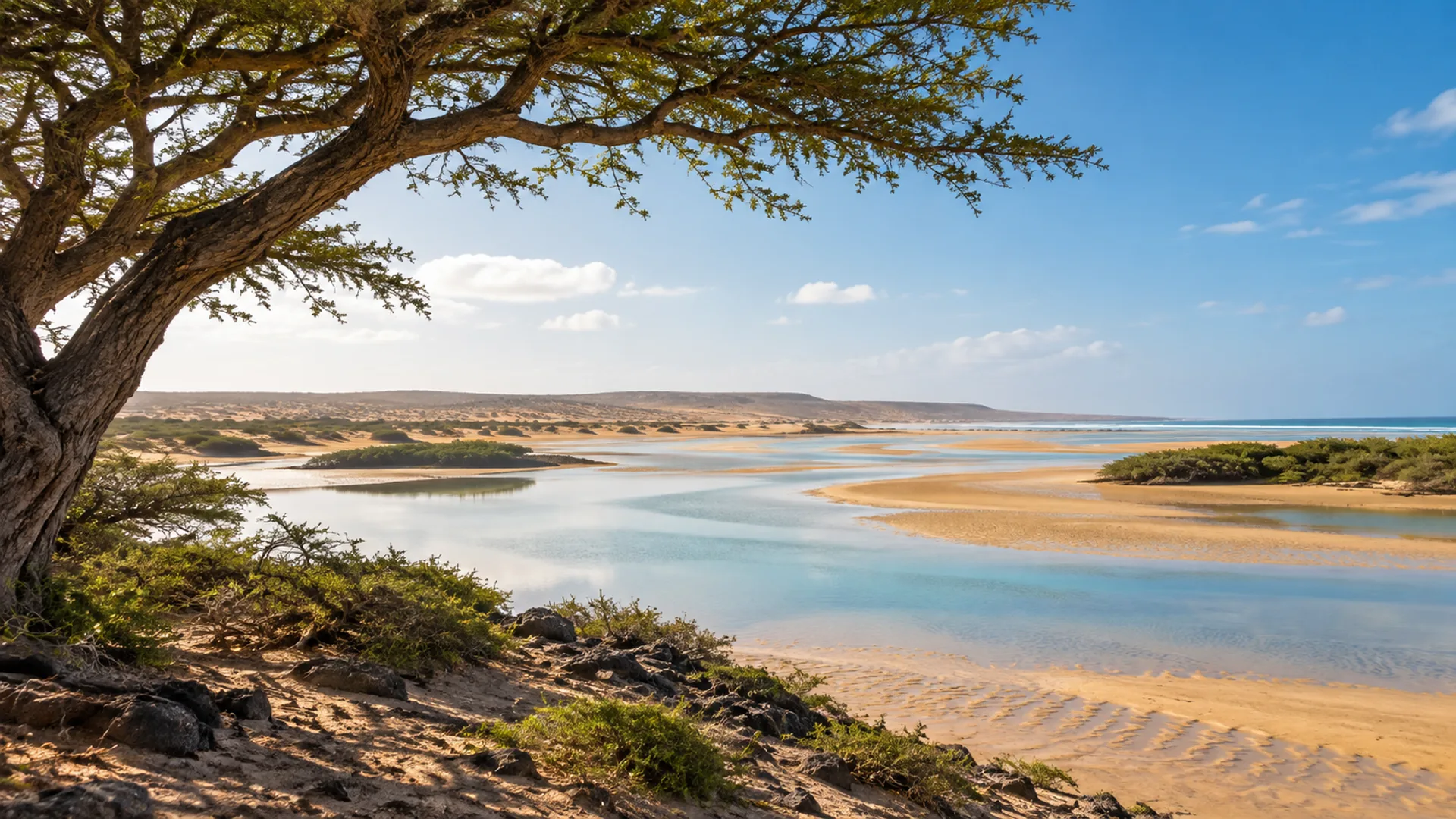
Maio invites you to assess the territory with attention to the scale of places, accessibility and the relationship between economic initiative and environment. For a house, a plot or a project, the first step is to understand what exists today and to separate future assumptions from conditions that can already be verified. This guide proposes a deep‑dive pathway before making decisions.
Landscape, places and identity
The Maio fact sheet of the Embassy of Cape Verde in Brazil describes the predominantly flat terrain, the history linked to salt and the coastal landscapes. A visit can help understand the relationship between settled centres, open spaces and local activities, avoiding reading the island solely through a beach photograph.
For a property, location also means access routes, services and management organisation. A plot that appears close to a centre on a map must be verified on site: actual route, access conditions, infrastructure and activities required for the intended use.
Someone looking for a house should devote time to daily habits: how to shop, reach relevant services and organise maintenance or assistance. The quality of a stay and that of a residence are also measured through these concrete needs.
Understanding UNESCO recognition
The UNESCO Biosphere Reserve sheet for Maio records the 2020 recognition and a scope that includes the island and the marine area. It is an important reference for understanding its environmental context.
That recognition is not an urban planning sheet for an individual plot. Before envisaging an intervention, you must verify location, zoning, rights, permitted uses and procedures applicable with the competent authorities, using appointed professionals.
A project should clarify from the outset how it addresses water, energy, waste, access and future management. Defining these aspects is part of feasibility; an architectural representation alone does not demonstrate that the site can support the proposed programme.
Checking transport and access
To organise a visit and assess an initiative you need to examine the connection options available on the relevant dates. The operator portal CV Interilhas for Santiago also lists departures to Maio: timetables, availability and conditions must be checked directly before booking.
Project feasibility also requires distinguishing people’s travel from the transport of materials and equipment. A procurement plan should specify suppliers, deliveries, any storage, required vehicles and alternatives in case of schedule changes.
For an existing dwelling, ask how spares, maintenance and interventions are organised. A local contact and an inventory of fittings can make management costs and responsibilities clearer.
Assessing the land before the price
The assessment must start with the identification of the asset, the available rights and the accesses, proceeding with the constraints and the feasible project. Declared area, observed boundaries and documentation must be examined by competent professionals.
Acquisition cost is only one line item. Surveys, studies, procedures, infrastructure, works, supplies and management must also be considered. It is necessary to distinguish what is already available, what requires interventions and what remains subject to third‑party verifications or decisions.
A proposal to develop or add value to land should set out the steps required and the conditions for proceeding. The investment appraisal guide helps you assess funding needs, risks and exit assumptions.
Defining the scale of a project
The initial discussion should relate size, target users, services and resources that can actually be organised. If subsequent phases are envisaged, it is necessary to clarify what makes each phase usable and which common costs must be borne from the outset.
A hospitality proposal must be accompanied by demand verification and a management plan. It is not enough to envisage units or rooms: responsibilities for reception, cleaning, maintenance, supplies and relationships with users are required.
The economic timetable must also take dependencies into account: asset availability, verifications, authorisations, resources, service connections and construction. To organise this framework you can consult the real estate development guide.
MGM’s approach to Maio
MGM includes Maio among the territories in which to assess initiatives and land operations. This indication expresses an area of interest and does not announce completed acquisitions, approved subdivisions or opportunities already available to investors.
To propose an asset, prepare the location, identification, title or available right, accesses, existing documents and the owner’s objective. In the first message a brief description is sufficient; confidential documentation will be shared later through the agreed channels.
The team can then determine which further investigations make sense and the possible scope of collaboration. The initial phase must clarify the questions to be resolved before building a financial plan or assuming commitments.
Informative briefing from MGM Intelligence. The UNESCO reference describes the reserve, it does not certify the buildability of an asset. Transport conditions may change. Every initiative requires specific technical, environmental, legal and economic checks.